
Secure AI Data Annotation and Governance Platform
Please review our privacy policy and terms of service.

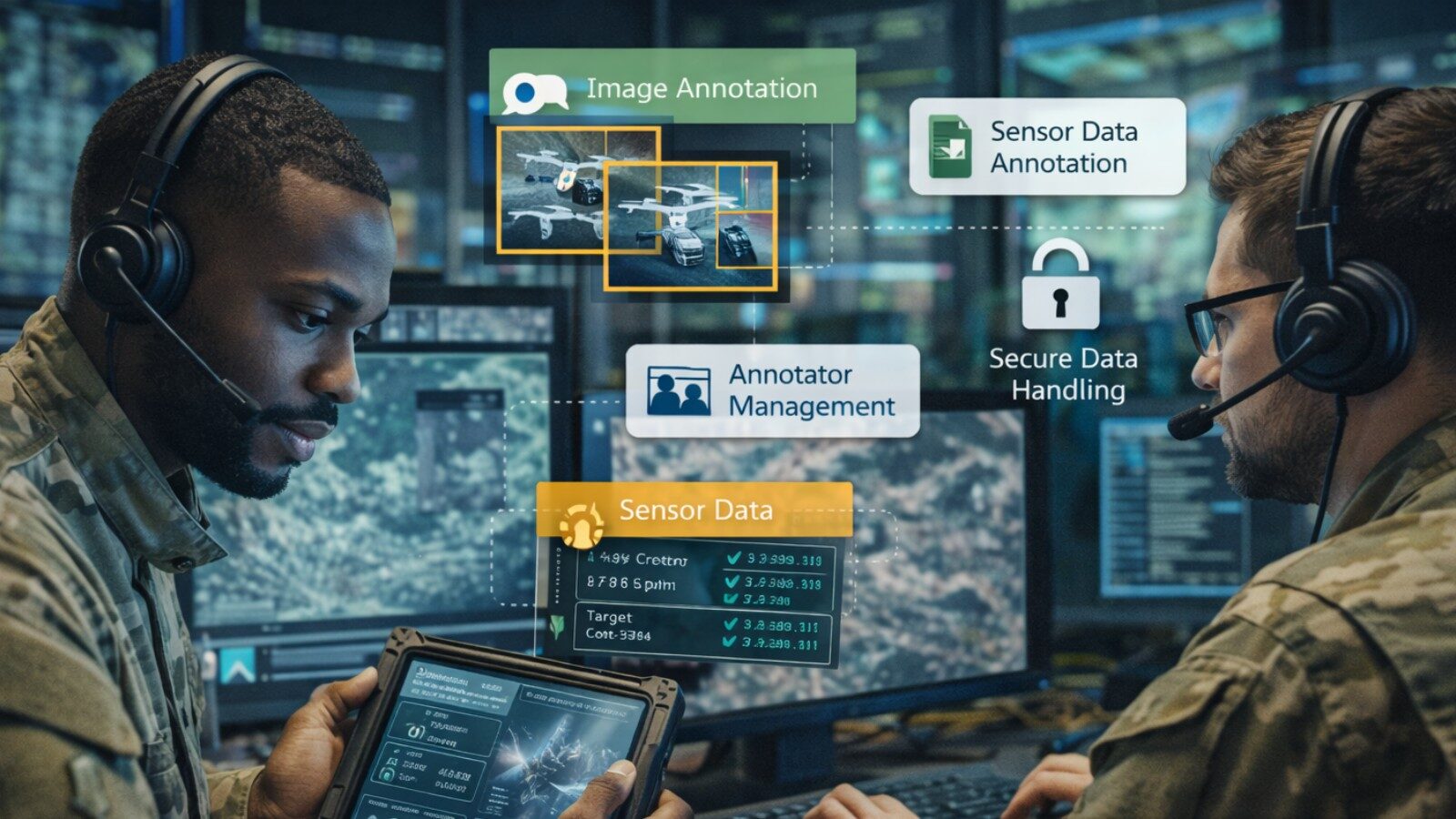

-
400% increase in annotation throughput (80 → 300 images/day)
-
35% improvement in label accuracy (65% → 92% agreement)
-
6-month schedule acceleration for AI model deployment
-
60% reduction in annotation costs
-
40% fewer annotations required via active learning
-
IL5 compliance achieved for classified data
-
120 concurrent annotators supported
-
95% object detection accuracy achieved
Our customer, a defense contractor supporting U.S. Department of Defense AI initiatives, needed to annotate 2M+ images and 50K+ hours of video for object detection and activity recognition models. Manual annotation processes lacked quality control, annotator accountability, and security controls required for classified defense data.
Remaker Digital built a secure, enterprise-grade data annotation platform that increased annotation throughput by 400%, improved label accuracy by 35%, and achieved IL5 compliance for classified data handling—enabling the customer to deliver defense AI models 6 months ahead of schedule.
Business Context
The defense contractor was developing computer vision models for autonomous systems, threat detection, and intelligence analysis. Their AI training programs required massive annotated datasets:
- Image annotation: 2M+ satellite, drone, and sensor images
- Video annotation: 50K+ hours of surveillance and activity footage
- Text annotation: 500K+ intelligence reports and communications
- Annotation team: 120 annotators (mix of in-house and cleared contractors)
- Project timeline: 18-month model development program
- Security requirement: Impact Level 5 (IL5) for classified data
Data Annotation Challenges
The contractor faced critical bottlenecks in annotation workflows:
- Low Throughput: Manual processes limited to 50-80 images per annotator per day
- Quality Inconsistency: Inter-annotator agreement at 65% (target: 90%+)
- No Performance Tracking: Couldn’t identify low-performing annotators or skill gaps
- Security Risks: Annotators accessed data via unsecured file shares and consumer tools
- Inefficient Task Assignment: Manual task distribution wasted time on low-value annotations
- Limited Collaboration: No structured review or consensus mechanisms
Without a scalable annotation platform, the AI model development program risked missing critical deadlines for operational deployment.
Existing Infrastructure
The contractor’s annotation environment included:
- Annotation Tools: Mix of CVAT, LabelImg, and custom scripts (no centralized platform)
- Data Storage: On-premises file shares with manual access control
- Quality Control: Spreadsheet-based sampling and manual review
- Security: VPN access to internal network, no IL5-compliant environment
- Task Management: Jira for high-level tracking, manual annotator assignment
- ML Pipeline: Kubeflow for model training once annotations complete
Technical Requirements
The solution needed to:
- Support image, video, text, and sensor data annotation
- Achieve IL5 compliance for classified defense data (Impact Level 5)
- Integrate with existing Kubeflow ML pipeline for active learning
- Scale to 120+ concurrent annotators with performance tracking
- Implement multi-stage quality assurance workflows (review, consensus, arbitration)
- Deploy in air-gapped, on-premises environment (no internet access)
- Provide real-time dashboards for program managers and ML engineers
- Support custom annotation schemas for defense-specific use cases
Discovery & Compliance Assessment (2 weeks)
Conducted stakeholder interviews with annotation team leads, ML engineers, and security officers. Analyzed existing annotation workflows and quality metrics. Documented IL5 compliance requirements and security controls. Assessed Kubeflow integration requirements for active learning. Reviewed 1,000+ existing annotations to understand quality challenges.
Architecture Design & Security Framework (3 weeks)
Designed annotation platform architecture for air-gapped deployment. Created quality assurance workflow with multi-stage review. Designed skill-based task routing and performance tracking system. Developed IL5 security controls documentation (200+ page ATO package). Defined custom annotation schemas for defense-specific use cases. Planned Kubeflow integration for active learning loop.
Development & Security Hardening (6 weeks)
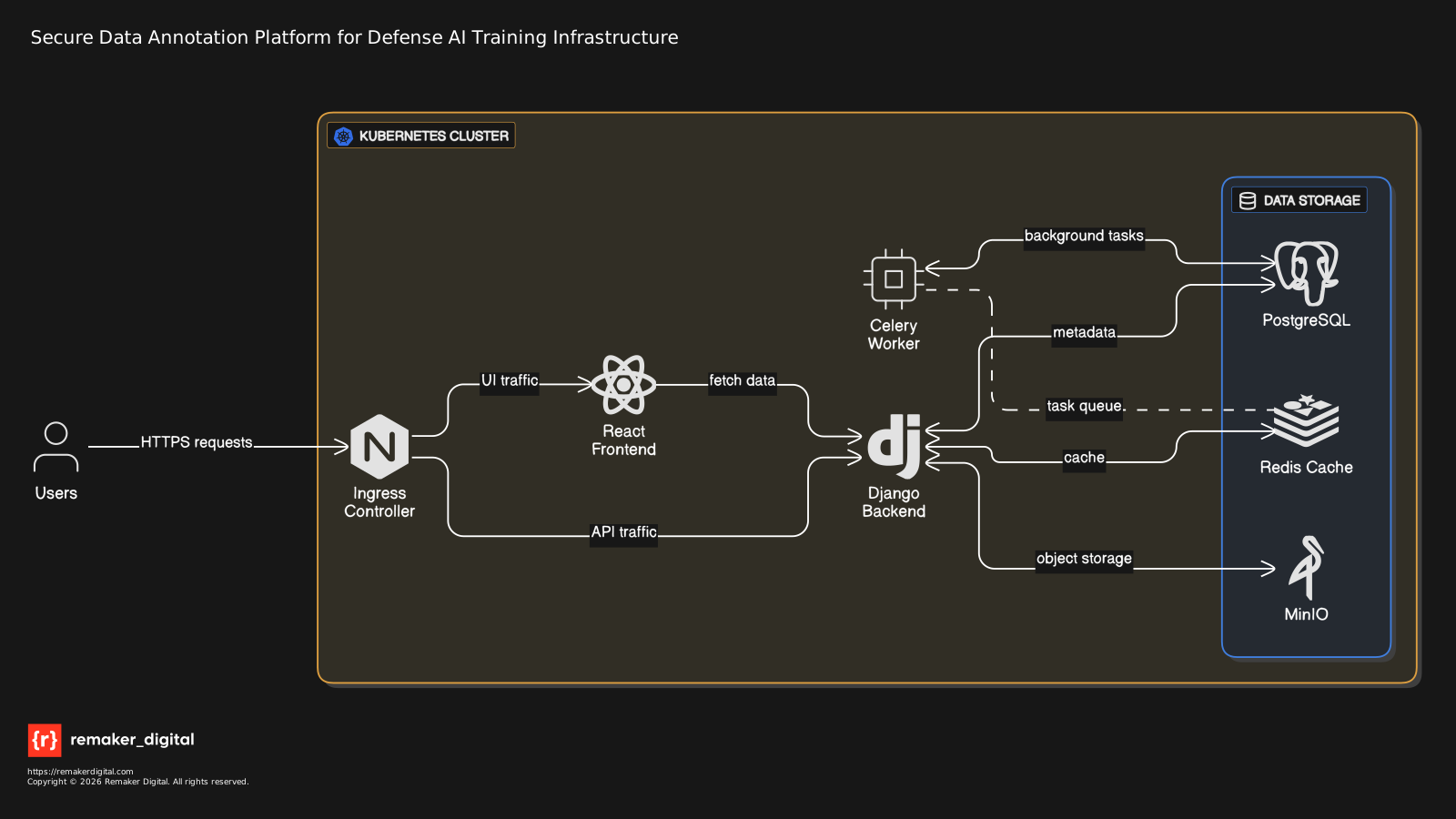
Built React annotation interface supporting image, video, and text modalities. Developed Django REST Framework backend with PostgreSQL database. Implemented multi-stage quality assurance workflows with inter-annotator agreement calculations. Created annotator performance tracking and leaderboard system. Built Kubeflow connector for active learning integration. Hardened platform for IL5 compliance (encryption, audit logging, access controls).
Testing & Compliance Validation (3 weeks)
Conducted security testing and penetration testing for IL5 compliance. Tested annotation workflows with 20 pilot annotators across all modalities. Validated quality assurance workflows with golden dataset samples. Load tested platform for 120 concurrent users. Achieved 92% inter-annotator agreement in pilot testing. Completed ATO documentation review with security team.
Pilot Deployment & Training (2 weeks)
Deployed platform in classified environment with 40 annotators. Conducted training sessions on annotation interface and quality standards. Integrated with Kubeflow ML pipeline for active learning. Processed 50K annotations during pilot phase. Achieved 300 images/day per annotator throughput. Refined task routing and performance metrics based on feedback.
Full Rollout & IL5 ATO (1 week)
Full rollout to 120 annotators across all defense AI programs. Obtained IL5 Authority to Operate (ATO) from security authorization official. Established weekly quality review meetings with ML engineering team. Deployed active learning integration for all annotation tasks. Achieved target metrics: 300 images/day, 92% agreement, IL5 compliance. Delivered comprehensive documentation and training materials.
IL5 Compliance in Air-Gapped Environment
Deploying a modern web application in an air-gapped, classified environment created unique challenges:
- No External Dependencies: All npm packages, Docker images, and Python libraries bundled offline
- Manual Updates: Security patches delivered via encrypted physical media
- Certificate Management: Internal PKI infrastructure for TLS certificates
- Compliance Documentation: 200+ page ATO package covering security controls, system architecture, and risk assessment
Annotator Performance Without Punitive Culture
Tracking performance while maintaining annotator morale required careful design:
- Positive Reinforcement: Leaderboards and skill certifications emphasize growth, not punishment
- Training, Not Termination: Low performers receive targeted feedback and retraining modules
- Transparency: Annotators see their own metrics and understand quality standards
- Fair Comparisons: Normalized metrics account for task difficulty (complex vs. simple annotations)
Active Learning Integration Complexity
Integrating with Kubeflow ML pipeline for uncertainty-based annotation prioritization:
- Model Uncertainty Scores: Kubeflow exports prediction confidence for each image
- Dynamic Prioritization: Annotation queue automatically reprioritizes based on model feedback
- Feedback Loop: New annotations trigger model retraining, updating uncertainty scores
- Performance Gains: Active learning reduced required annotations by 40% compared to random sampling
Multi-Modal Annotation Consistency
Ensuring consistent quality across image, video, and text annotations:
- Unified Quality Metrics: Common accuracy thresholds across all modalities
- Cross-Modal Review: Video annotators periodically review image annotations to maintain standards
- Schema Standardization: Consistent label taxonomies across image, video, and text tasks
Annotation Throughput & Quality Gains
The annotation platform transformed defense AI data preparation:
- 400% increase in throughput: From 50-80 images/day to 200-300 images/day per annotator
- 35% improvement in label accuracy: Inter-annotator agreement increased from 65% to 92%
- 6-month schedule acceleration: AI model development completed ahead of schedule
- 120 concurrent annotators: Seamlessly scaled to full team capacity
- IL5 compliance achieved: Full ATO granted for classified data handling
Cost Efficiency
Annotation efficiency gains delivered significant cost savings:
- 60% reduction in annotation costs: Through automation and workflow efficiency
- 40% fewer annotations required: Active learning eliminated low-value annotations
- Reduced rework: Quality assurance workflows prevented costly error propagation
Program Success Impact
The platform enabled successful delivery of defense AI program:
- Model performance targets met: 95% object detection accuracy achieved
- Operational deployment: AI models deployed to field systems 6 months early
- Follow-on contracts: Platform reused for 3 additional defense AI programs
- Industry recognition: Featured in DoD AI innovation showcase
Lessons Learned
- Quality Assurance is Non-Negotiable: Multi-stage review workflows and inter-annotator agreement metrics are essential for high-stakes defense applications. 92% agreement vs. 65% baseline justified the investment.
- Annotator Performance Tracking Drives Improvement: Transparent metrics and skill-based task routing increased productivity while maintaining team morale through positive reinforcement.
- Active Learning Reduces Annotation Requirements: Prioritizing uncertain samples cut required annotations by 40%, demonstrating the value of ML-human collaboration.
- IL5 Compliance Requires Upfront Design: Security controls can’t be retrofitted. Air-gapped deployment, audit logging, and compliance documentation must be architectural foundations.
- Scalable Platforms Enable Program Success: The annotation platform became a strategic asset, reused across multiple defense AI programs and generating long-term value beyond the initial project.
Appendices
Integration Overview
The system integrates with defense AI infrastructure through:
- Kubeflow ML Pipeline: Exports annotated data in COCO, YOLO, and custom formats; receives model uncertainty scores for active learning
- MinIO Object Storage: S3-compatible storage for images, videos, and sensor data in air-gapped environment
- PKI Infrastructure: Internal certificate authority for TLS certificates and mutual authentication
- Active Directory: LDAP integration for user authentication and role-based access control
- Secure Workstations: Annotators access platform via hardened Windows 10 workstations with no removable media
Model Selection Rationale
The platform itself does not use LLMs for annotation (human annotators perform labeling). However, it integrates with defense AI models for active learning:
Active Learning Integration: ML models (typically YOLOv8, Faster R-CNN, or custom architectures) trained in Kubeflow generate uncertainty scores for each unlabeled sample. Platform prioritizes annotations for high-uncertainty samples, reducing total annotations required by 40%.
Quality Assurance Automation: Automated flagging uses statistical outlier detection (not ML) to identify low-confidence annotations for expert review.
Cost Analysis
Platform development and operational costs:
- Development Costs: $450K (4-month project with 6-person team)
- IL5 Compliance Costs: $120K (ATO documentation, security testing, penetration testing)
- Infrastructure Costs: $80K (on-premises Kubernetes cluster, storage, networking)
- Operational Costs: $15K/month (system administration, maintenance, security updates)
Security Architecture (IL5 Compliance)
Impact Level 5 security controls for classified defense data:
- Air-Gapped Deployment: No external network connectivity; all updates via encrypted physical media
- Access Control: Multi-factor authentication (CAC + PIN), role-based access control (RBAC)
- Data Encryption: AES-256 encryption at rest, TLS 1.3 in transit, FIPS 140-2 compliant cryptography
- Audit Logging: All user actions logged to write-once audit database with 7-year retention
- Network Segmentation: Platform deployed in isolated VLAN with firewall rules
- Secure Workstations: Annotators use hardened Windows 10 workstations with disabled USB ports, no removable media, full disk encryption
- Compliance: NIST 800-53 High baseline controls, CMMC Level 3, FedRAMP High equivalent
- Availability: 99.9% uptime SLA, Kubernetes high availability with 3 control plane nodes, daily backups with 30-day retention
- Incident Response: 24/7 security monitoring, incident response playbooks, annual penetration testing
-
Multi-modal annotation (image, video, text, sensor telemetry)
-
Quality assurance workflows with multi-reviewer consensus
-
Annotator performance tracking and skill-based task routing
-
Active learning integration to prioritize high-value annotations
-
Secure annotation environment with classified data handling (IL5 compliance)
-
Custom annotation schemas for domain-specific defense applications
-
Real-time annotation progress dashboards and quality metrics
The annotation platform leverages Django REST Framework, React, and Kubeflow integration to deliver secure, scalable data annotation with IL5 compliance, quality assurance workflows, and active learning for defense AI applications.