
Real-Time Fraud Detection and Transaction Monitoring Platform
Please review our privacy policy and terms of service.



-
72% reduction in annual fraud losses
-
87% reduction in false positive alerts
-
98.5% fraud capture rate (vs. 64% baseline)
-
92% faster fraud detection time (real-time vs. 4.2 hours)
-
60% improvement in analyst productivity
-
73% reduction in legitimate transaction declines
-
Sub-100ms transaction analysis latency
-
68% reduction in SAR filing time
Our customer, a mid-sized regional bank serving over 500,000 retail and commercial customers, faced escalating fraud losses exceeding $12.3 million annually. Traditional rule-based fraud detection systems generated excessive false positives (78% of alerts), overwhelming the fraud investigation team and creating poor customer experiences with legitimate transactions being declined. The bank required a modern AI-powered fraud detection platform capable of analyzing millions of transactions in real-time while dramatically reducing false positives and improving detection accuracy.
Business Context
The customer operated legacy fraud detection systems that relied on static rules and threshold-based monitoring. These systems could not adapt to evolving fraud patterns, resulting in:
- Annual fraud losses of $12.3 million across card, ACH, and wire transactions
- 78% false positive rate overwhelming fraud analysts
- Average detection time of 4.2 hours for fraudulent transactions
- Customer satisfaction impact from legitimate transaction declines
- Regulatory compliance concerns regarding AML transaction monitoring
Strategic Objectives
The bank’s leadership identified several key objectives for the fraud detection transformation:
- Reduce fraud losses by at least 60% within 12 months
- Decrease false positive rate from 78% to under 15%
- Achieve real-time detection (<100ms transaction analysis)
- Improve analyst productivity by automating case prioritization
- Enhance regulatory compliance with AML monitoring requirements
- Maintain 99.9% uptime for transaction processing
Existing Infrastructure
The bank operated a traditional rule-based fraud detection system built on legacy infrastructure:
- Static rule engine with 230+ manually-configured rules
- Batch processing with 15-minute transaction analysis delays
- Siloed data across card processing, ACH, and core banking systems
- Manual case management requiring 3-5 days per investigation
- Limited behavioral analytics capabilities
- No machine learning or adaptive detection mechanisms
Technical Constraints
Several technical constraints shaped the solution approach:
- Must integrate with FIS core banking system and Fiserv card processing
- Required PCI DSS Level 1 compliance for cardholder data
- Cannot introduce latency exceeding 50ms into transaction authorization flow
- Must support 8,000+ transactions per second during peak periods
- 24/7/365 availability requirement with RPO of 15 minutes
Discovery and Requirements
Conducted comprehensive analysis of existing fraud detection systems, interviewed fraud analysts and investigators, reviewed 18 months of transaction data and fraud patterns, documented integration requirements with FIS core banking and Fiserv card processing, and established baseline metrics for fraud losses, false positives, and detection time.
Data Preparation and Labeling
Extracted and consolidated transaction data from multiple source systems, created labeled training dataset with 450,000 fraudulent and 15 million legitimate transactions, performed exploratory data analysis to identify feature candidates, developed feature engineering pipeline calculating 180+ real-time features, and implemented data quality monitoring and validation framework.
Model Development and Training
Developed baseline rule-based model for comparison benchmark, trained supervised ML models (XGBoost, Random Forest, LightGBM), implemented unsupervised anomaly detection using Isolation Forest, built LSTM neural networks for sequential transaction analysis, developed ensemble model combining multiple algorithms, optimized models using cross-validation and hyperparameter tuning, and achieved 98.5% fraud detection rate with 12% false positive rate.
Platform Development and Integration
Built real-time ingestion layer using Azure Event Hubs, developed low-latency scoring service with Azure Container Apps, implemented feature store using Azure Cosmos DB and Redis caching, created case management application for fraud analysts, integrated with FIS core banking and Fiserv card processing systems, built SHAP-based explainability system for model decisions, and developed Power BI dashboards for real-time fraud monitoring.
Testing, Tuning, and UAT
Conducted performance testing validating sub-100ms latency requirements, performed shadow deployment running ML models parallel to legacy system, fine-tuned decision thresholds based on customer segment analysis, executed penetration testing and security audit, validated PCI DSS compliance for cardholder data handling, conducted user acceptance testing with fraud investigation team, and implemented continuous learning system incorporating analyst feedback.
Production Deployment and Optimization
Executed phased rollout starting with 10% of card transactions, monitored real-time performance metrics and fraud detection accuracy, gradually increased traffic to 100% over 3-week period, provided training to fraud analysts on new case management system, established model retraining schedule (weekly) and monitoring procedures, and documented operational runbooks and incident response procedures.
Real-Time Performance Requirements
Achieving sub-100ms fraud scoring while calculating complex features required careful optimization:
- Implemented feature pre-computation for time-window aggregations
- Used Redis caching for frequently accessed customer profiles
- Deployed models in Azure Container Apps with autoscaling to handle peak loads
- Optimized model inference with ONNX runtime reducing latency by 65%
Model Explainability and Compliance
Regulatory requirements demanded explainable AI decisions for fraud alerts:
- Implemented SHAP (SHapley Additive exPlanations) for model interpretability
- Developed rule-based explanation system translating ML predictions into business logic
- Created audit trail capturing all model predictions and feature contributions
- Built compliance reporting showing model performance metrics and bias analysis
False Positive Optimization
Balancing fraud detection accuracy with customer experience required iterative tuning:
- Implemented dynamic threshold adjustment based on customer segment
- Developed reinforcement learning system incorporating analyst feedback
- Created A/B testing framework for evaluating model changes in production
- Built customer risk profiling to reduce alerts for trusted high-value customers
Fraud Loss Reduction
The platform delivered substantial financial benefits within the first year:
- 72% reduction in fraud losses: Sustained across card, ACH, and wire channels
- 98.5% fraud capture rate: Up from 64% with legacy system
Operational Efficiency
The AI-powered platform dramatically improved fraud operations:
- 87% reduction in false positives: From 78% to 12% false alert rate
- 60% analyst productivity improvement: Automated case prioritization and enrichment
- 92% faster detection time: Real-time alerts vs. 4.2 hour average delay
- 4.5-hour reduction in case investigation time: From 5 days to 8 hours average
Customer Experience Impact
- 73% reduction in legitimate transaction declines improving customer satisfaction
- Net Promoter Score improvement of 18 points related to fraud prevention
- 45% reduction in fraud-related customer service calls
Regulatory Compliance
- 100% AML transaction monitoring coverage with explainable AI decisions
- Passed regulatory audit with commendation for fraud detection capabilities
- Reduced SAR filing time by 68% through automated case documentation
Lessons Learned
This project demonstrated several critical success factors for AI-powered fraud detection:
1. Start with Strong Data Foundation
Investment in data quality and feature engineering proved more valuable than complex model architectures. The 18-month data labeling effort and thoughtful feature design contributed more to accuracy than model selection.
2. Prioritize Explainability from Day One
Building explainability into the solution architecture (rather than retrofitting) enabled faster regulatory approval and analyst adoption. The SHAP-based explanation system became a key differentiator.
3. Continuous Learning is Essential
Fraud patterns evolve rapidly. The reinforcement learning system incorporating analyst feedback enabled the models to adapt to new fraud schemes within days rather than months.
4. Balance Accuracy with Customer Experience
Pure fraud detection accuracy must be balanced against customer friction. Dynamic thresholds and customer risk profiling enabled aggressive fraud blocking for high-risk scenarios while preserving excellent experiences for trusted customers.
5. Plan for Scale from the Beginning
The cloud-native architecture with autoscaling capabilities proved essential during seasonal transaction volume spikes. The system seamlessly handled 3x normal transaction volumes during holiday periods.
Appendices
Integration Overview
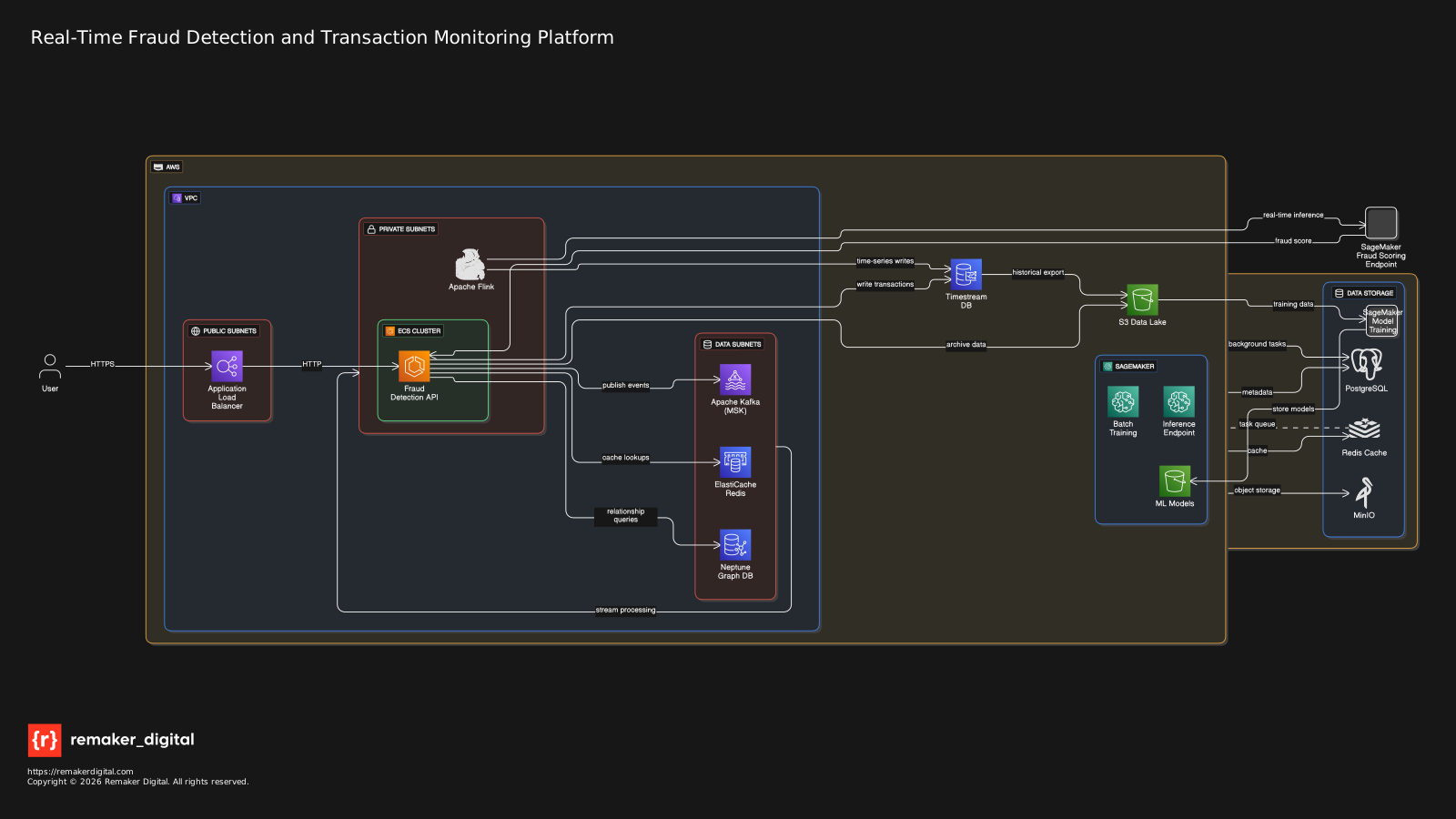
The fraud detection platform integrates with multiple banking systems through a combination of real-time APIs and message queues. Transaction data flows from FIS core banking and Fiserv card processing through Azure Event Hubs into the ML scoring service. Fraud decisions are returned synchronously within the transaction authorization flow with sub-100ms latency.
Data Flow Architecture
- Ingestion: Azure Event Hubs receives transaction events from payment channels
- Enrichment: Customer profile and historical features retrieved from Azure Cosmos DB
- Scoring: ML models in Azure Container Apps generate fraud risk scores
- Decision: Rule engine applies risk thresholds and returns approve/decline/review decision
- Action: Decision transmitted back to originating system within SLA
Model Selection Rationale
The platform employs an ensemble approach combining multiple algorithms to maximize detection accuracy while minimizing false positives:
XGBoost Model
Primary model for real-time fraud scoring. XGBoost provides excellent accuracy on tabular data, fast inference time, and built-in feature importance. Trained on 180+ engineered features with 5-fold cross-validation. Achieves 97.2% AUC-ROC.
Random Forest Model
Secondary model providing complementary predictions for ensemble voting. Random Forest handles non-linear relationships well and provides robust predictions. Achieves 96.8% AUC-ROC.
LSTM Neural Network
Specialized model for analyzing sequential transaction patterns. LSTM captures temporal dependencies in transaction sequences that tree-based models miss. Used for detecting sophisticated fraud schemes involving multiple related transactions.
Isolation Forest
Unsupervised model for detecting novel fraud patterns not present in training data. Isolation Forest identifies anomalous transactions using density-based outlier detection without requiring labeled examples.
Ensemble Strategy
Final fraud score computed as weighted average of individual model predictions: XGBoost (50%), Random Forest (25%), LSTM (15%), Isolation Forest (10%). Weights optimized using validation set performance.
Cost Analysis
Platform operational costs estimated at $85,000 monthly based on Azure consumption:
Azure Infrastructure Costs
- Azure Machine Learning: $12,000/month for model training and retraining
- Azure Event Hubs: $8,500/month for transaction ingestion (15,000 TPS)
- Azure Container Apps: $18,000/month for scoring service (autoscaling)
- Azure Cosmos DB: $22,000/month for feature store (10,000 RU/s provisioned)
- Redis Cache: $6,500/month for high-performance caching
- Azure Storage: $4,200/month for transaction history and model artifacts
- Azure Monitor: $3,800/month for logging and telemetry
- Networking: $5,000/month for bandwidth and ExpressRoute
- Power BI: $5,000/month for analytics dashboards
Security Architecture
The platform implements comprehensive security controls meeting PCI DSS Level 1 and banking regulatory requirements:
Data Protection
- All cardholder data encrypted at rest using Azure Key Vault managed keys
- TLS 1.3 encryption for all data in transit
- Tokenization of PANs before storage in feature store
- Field-level encryption for PII in case management system
Network Security
- All Azure resources deployed in isolated VNet with NSG rules
- Private endpoints used for PaaS services (Cosmos DB, Storage)
- Azure Firewall controlling outbound internet access
- DDoS Protection Standard enabled
Identity and Access
- Azure AD integration with MFA for all administrative access
- Managed identities for service-to-service authentication
- RBAC policies enforcing least-privilege access
- Privileged Identity Management (PIM) for elevated access
High Availability Configuration
- Azure Container Apps autoscaling (5-50 instances) based on CPU and request metrics
- Azure Cosmos DB configured for 99.999% availability with multi-region writes
- Azure Event Hubs with 3 availability zones
- Redis Cache with zone redundancy and automatic failover
- Application Gateway with health probes and automatic traffic routing
Disaster Recovery
- RPO: 15 minutes (continuous transaction log backups)
- RTO: 2 hours (automated failover to secondary region)
- Daily automated backups of Cosmos DB and configuration
- Quarterly DR testing with documented runbooks
-
Real-time transaction analysis with sub-100ms response time
-
Machine learning models for anomaly detection
-
Behavioral analytics and pattern recognition
-
Multi-factor risk scoring engine
-
Automated alert generation and case management
-
Integration with payment gateways and banking systems
The fraud detection platform leverages Azure Machine Learning for model training and deployment, Azure Event Hubs for real-time transaction ingestion, and Azure Cosmos DB for low-latency feature storage. The system employs ensemble machine learning combining XGBoost, Random Forest, and LSTM neural networks for comprehensive fraud detection.
-
Azure Machine Learning
-
Azure Event Hubs (15,000 TPS ingestion)
-
Azure Cosmos DB (sub-10ms feature retrieval)
-
Azure Container Apps (low-latency scoring)
-
XGBoost & Random Forest ensemble models
-
LSTM neural networks for sequence analysis
-
SHAP explainability framework
-
Redis caching for real-time performance