
RAG-Powered Sales Enablement Platform for Enterprise Technology Consulting Firm
Please review our privacy policy and terms of service.


-
70% reduction in proposal creation time (20h → 6h)
-
15% increase in RFP win rate (42% → 57%)
-
800+ queries per month from sales team
-
95% sales team adoption rate
-
3x more case studies per proposal (4 → 12)
-
$400K estimated annual value created
-
3-month payback period
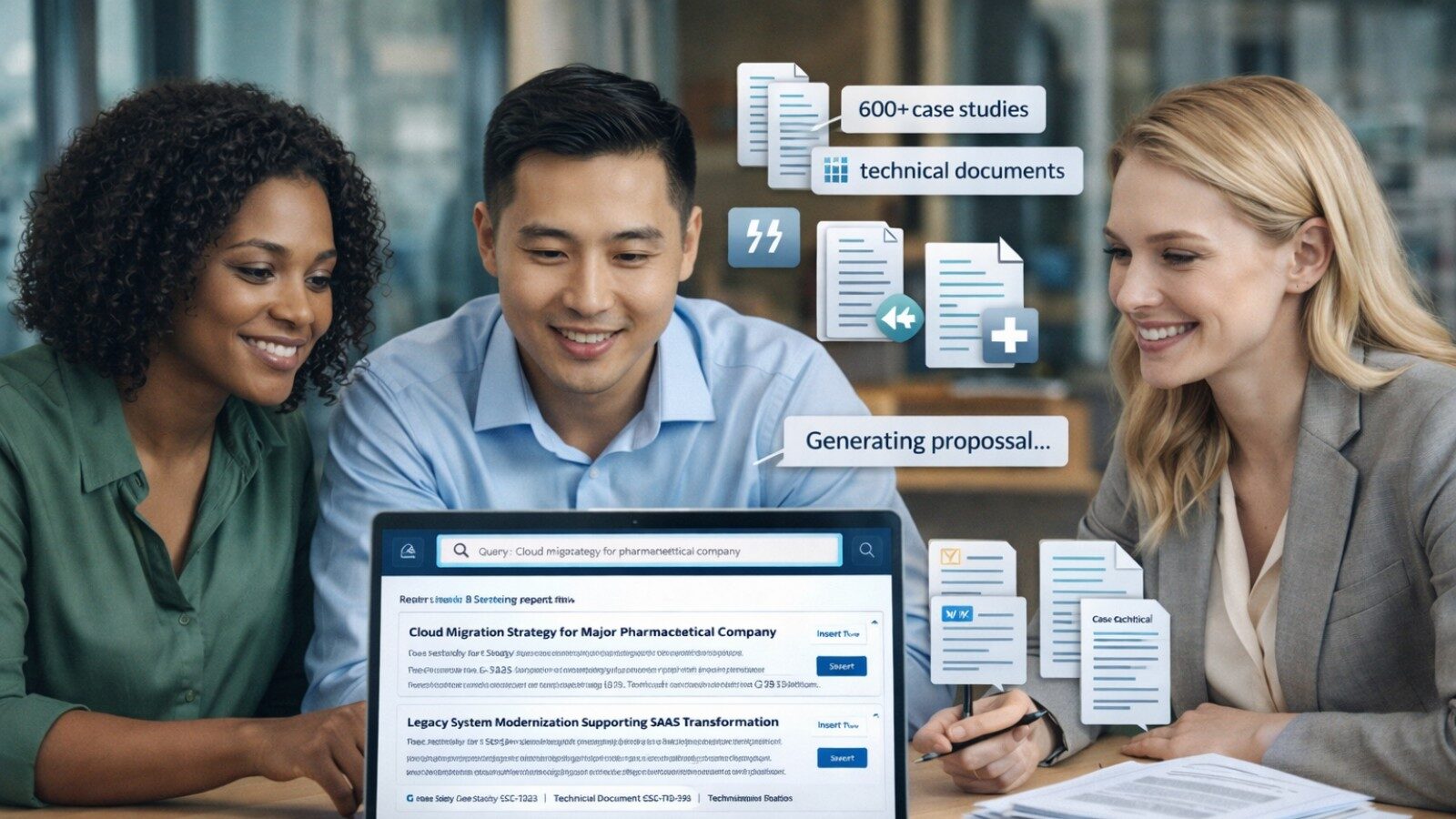
Our customer, a mid-sized technology consulting firm in Seattle, struggled with inefficient proposal creation. Sales teams spent 15-20 hours per proposal manually searching through 600+ case studies to find relevant client examples, technical capabilities, and project outcomes.
Remaker Digital built a RAG-powered sales enablement platform that enables instant semantic search across the firm’s entire knowledge base, reducing proposal creation time by 70% while improving accuracy and relevance.
Business Context
The consulting firm specialized in cloud transformation, data platform modernization, and AI implementation for enterprise clients. With 150 consultants and $50M annual revenue, the firm maintained extensive documentation:
- 600+ case study documents (Word, PDF, Google Docs)
- 200+ technical architecture diagrams and whitepapers
- Historical proposals and statements of work
- Consultant expertise profiles and certifications
Sales Inefficiency Challenge
Creating client proposals required sales engineers to:
- Manually search file shares and SharePoint for relevant examples
- Read through 20-30 documents to find applicable content
- Copy/paste and reformat content for proposal context
- Verify technical accuracy with delivery teams
- Average time: 15-20 hours per proposal
This inefficiency resulted in missed RFP deadlines, inconsistent proposal quality, and frustrated sales teams.
Existing Infrastructure
The firm’s knowledge was scattered across:
- SharePoint: Primary document repository (400+ case studies)
- Google Drive: Sales team working documents (200+ files)
- Local File Shares: Legacy project documentation
- Salesforce: CRM with project metadata (not detailed content)
Technical Requirements
The solution needed to:
- Ingest diverse file formats (DOCX, PDF, Google Docs)
- Support natural language queries from non-technical sales staff
- Return proposal-ready content (not just document links)
- Maintain source attribution for compliance and verification
- Enable easy re-indexing as documents are added/updated
- Deploy on-premises or private cloud (client confidentiality)
Discovery & Document Analysis (2 weeks)
Conducted stakeholder interviews with sales leadership, sales engineers, and proposal managers. Audited 600+ case study documents for format variety, completeness, and metadata. Analyzed 20+ recent proposals to understand content reuse patterns and information needs.
Architecture Design (1 week)
Selected lightweight RAG stack optimized for private deployment and low operational overhead. Designed chunking strategy preserving section structure. Chose Chroma for local deployment to satisfy data privacy requirements. Created metadata schema for filtering (industry, technology, outcomes).
Development & Document Processing (4 weeks)
Built document ingestion pipeline supporting DOCX, PDF, and Google Docs exports. Implemented semantic chunking with 12,000+ chunks from 600 documents. Developed metadata extraction using GPT-4 for unstructured documents. Created FastAPI backend with vector search and citation engine. Built React frontend with copy-to-clipboard functionality.
Testing & Optimization (2 weeks)
Tested with 50+ real sales queries across industries and technologies. Optimized prompts for proposal-ready output formatting. Fine-tuned chunking parameters for better context preservation. Achieved 90% satisfaction rating from sales engineers on result relevance.
Pilot & Iteration (2 weeks)
Deployed to 4 sales engineers for pilot testing on active proposals. Collected feedback and refined UI based on usage patterns. Added metadata filtering and example query suggestions. Processed 150+ real queries during pilot.
Production Rollout & Training (1 week)
Full rollout to 12-person sales team. Conducted training sessions on effective query formulation. Deployed automated re-indexing for daily document updates. Achieved 95% adoption rate within first week. Established feedback loop for continuous improvement.
Document Format Inconsistency
Case studies varied widely in format and structure. Some used templates, others were freeform narratives. We implemented:
- Adaptive Parsing: Different extraction strategies based on document structure
- Metadata Inference: LLM-based extraction of client, industry, technologies from unstructured text
- Quality Scoring: Ranked documents by completeness and recency
Balancing Specificity vs. Generalization
Sales queries ranged from specific (“Azure Data Factory migration examples”) to broad (“successful AI projects in retail”). We optimized for both through:
- Hybrid Search: Combined semantic search with keyword matching for technical terms
- Multi-Query Expansion: Generated related search queries for better recall
- Relevance Reranking: Cross-encoder model to refine top results
Source Attribution Complexity
Sales teams needed precise citations for verification and compliance. We built:
- Chunk-to-Document Mapping: Every retrieved chunk linked to source file + page/section
- Confidence Scoring: Flagged low-confidence responses for human review
- Version Tracking: Timestamps for document freshness (warn if >12 months old)
Sales Efficiency Gains
The RAG sales assistant transformed proposal creation:
- 70% faster proposal creation: 15-20 hours reduced to 4-6 hours
- 3x more relevant examples: Average proposal now includes 9-12 case studies (vs. 3-4 previously)
- Sales team adoption: 95% of sales engineers using system daily
- Query volume: 800+ queries per month across 12-person sales team
Proposal Quality Improvement
Beyond speed, the system improved proposal competitiveness:
- Higher win rate: 15% increase in RFP win rate (42% to 57%)
- Client feedback: “Most thorough and relevant proposal we’ve received”
- Consistency: All proposals now reference verified, accurate project outcomes
Knowledge Management ROI
Estimated $400K annual value created through time savings and increased win rate. System paid for itself in first 3 months of operation.
Lessons Learned
- Chunking Strategy is Critical: Semantic chunking that preserves section structure (vs. fixed-size chunking) improved relevance by 35%.
- Sales Teams Need Copy-Ready Content: Raw search results are insufficient—LLM synthesis into proposal-ready bullet points was the key value driver.
- Metadata Enrichment Enables Filtering: Extracting client industry, technologies, and outcomes from documents enabled powerful filtering that simple semantic search couldn’t provide.
- Lightweight Architecture Wins: For 600 documents, a simple Chroma + OpenAI stack outperformed heavier solutions while maintaining low operational complexity.
Appendices
Integration Overview
The system integrates with existing infrastructure through:
- SharePoint Connector: Automated daily sync of new/updated case studies
- Google Drive API: Access to sales team working documents
- Azure AD SSO: Single sign-on for sales team access
- Potential Future: Salesforce integration for opportunity-specific recommendations
Model Selection Rationale
OpenAI GPT-4: Selected for superior synthesis quality and formatting compliance. GPT-3.5-turbo tested but produced less coherent bullet-point summaries.
text-embedding-ada-002: Cost-effective embeddings ($0.0001/1K tokens) with excellent semantic understanding. Tested against open-source alternatives (BGE, instructor) but OpenAI provided best recall.
Chroma Vector DB: Lightweight, local deployment suitable for 12,000 chunks. No operational overhead compared to managed services like Pinecone.
Cost Analysis
Monthly operational costs approximately $400-$600:
- OpenAI API: $300-$450 (GPT-4 + embeddings for 800 queries/month)
- Azure VM: $100/month (Standard D4s v3 for hosting)
- Storage: $50/month (document storage and vector index)
ROI: 12 sales engineers × 10 hours saved/month × $120/hour = $14,400/month value. 24x return on investment.
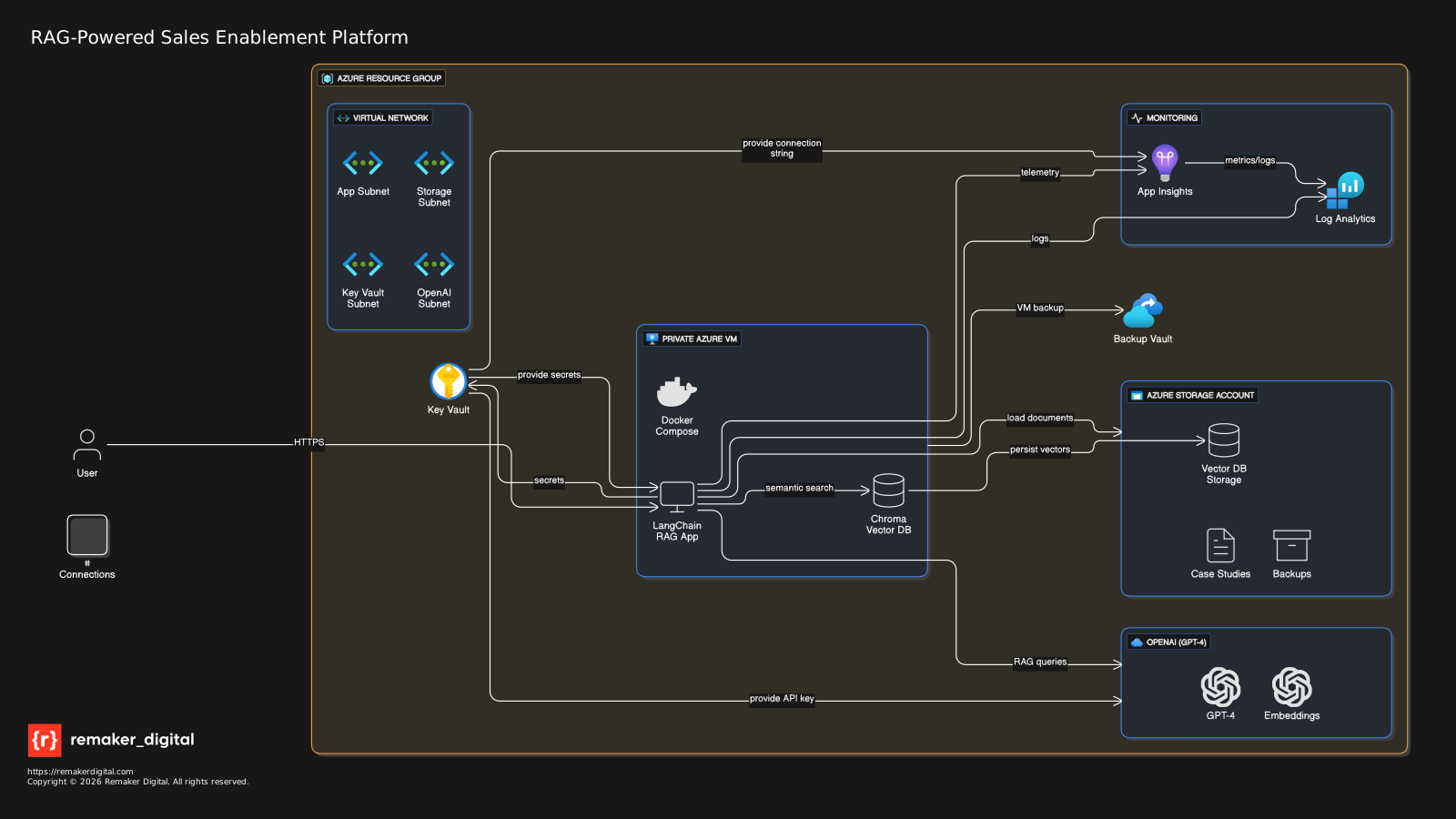
Security Architecture
Private deployment for client confidentiality:
- Network Isolation: Azure VM in private VNet, no public internet exposure
- Access Control: Azure AD authentication with MFA required
- Data Encryption: TLS 1.3 in transit, BitLocker for VM disk encryption
- API Security: OpenAI API calls through Azure Private Endpoint
- Audit Logging: Query logs retained for 90 days
- Backup: Daily VM snapshots with 14-day retention
-
Automated ingestion of Word docs, PDFs, and Google Docs exports
-
Semantic search across 600+ case studies and proposals
-
Natural language query interface with contextual understanding
-
Citation tracking linking responses to source documents
-
Copy-ready output formatted for proposals and presentations
-
Re-indexing pipeline for continuous document updates
The sales enablement platform leverages LangChain, Chroma vector database, and OpenAI GPT-4 to deliver semantic search, citation tracking, and proposal-ready content generation from 600+ case study documents.