
HIPAA-Compliant Medical Knowledge Assistant for Specialty Healthcare Practice
Please review our privacy policy and terms of service.



-
60% reduction in routine consultation volume
-
12 physician hours saved per week
-
400+ patient queries handled monthly
-
95% patient satisfaction with assistant responses
-
2,500+ medical documents indexed and searchable
-
100% HIPAA compliance maintained
-
Zero medical safety incidents
Our customer, a specialty healthcare practice in Boston, faced challenges scaling personalized patient education as their senior physician approached retirement. With 40+ years of clinical experience in integrative medicine, the physician wanted to preserve her unique approach to patient care while reducing her direct consultation load.
Remaker Digital designed and deployed a HIPAA-compliant AI medical knowledge assistant that captures the physician’s expertise, communication style, and clinical judgment, enabling the practice to maintain high-quality patient education at scale.
Business Context
The practice specialized in integrative and holistic medicine, serving 2,000+ active patients. The senior physician was the practice’s primary knowledge source, conducting 30+ patient consultations weekly. As she planned to reduce her clinical hours, the practice needed a solution to:
- Preserve and scale her specialized medical knowledge
- Maintain the warm, personal communication style patients valued
- Reduce routine consultation volume while maintaining quality
- Ensure strict HIPAA compliance and patient safety
- Enable junior practitioners to access expert guidance
Patient Education Challenge
Patients frequently asked similar questions about holistic treatments, supplement interactions, lifestyle modifications, and integrative approaches to chronic conditions. The physician spent 40% of consultation time answering foundational questions that could be addressed through structured knowledge resources.
Existing Infrastructure
The practice operated with:
- Electronic Health Records (EHR) system (Epic)
- Patient portal for appointment scheduling and messages
- Extensive library of physician-authored documents (2,500+ files)
- Recorded patient education sessions and webinars
- Published research papers and medical textbooks
Technical Constraints
The solution required:
- Full HIPAA compliance (no PHI in training data)
- Zero tolerance for medical misinformation or hallucinations
- Strict source attribution for all medical claims
- Safety escalation for urgent or high-risk queries
- Integration with existing patient portal (optional future phase)
Discovery & Requirements (3 weeks)
Conducted stakeholder interviews with senior physician, practice manager, and IT administrator. Analyzed 2,500+ source documents, reviewed patient query patterns, and documented HIPAA compliance requirements. Established voice fidelity criteria through analysis of 500+ historical patient communications.
Architecture Design & Compliance Planning (4 weeks)
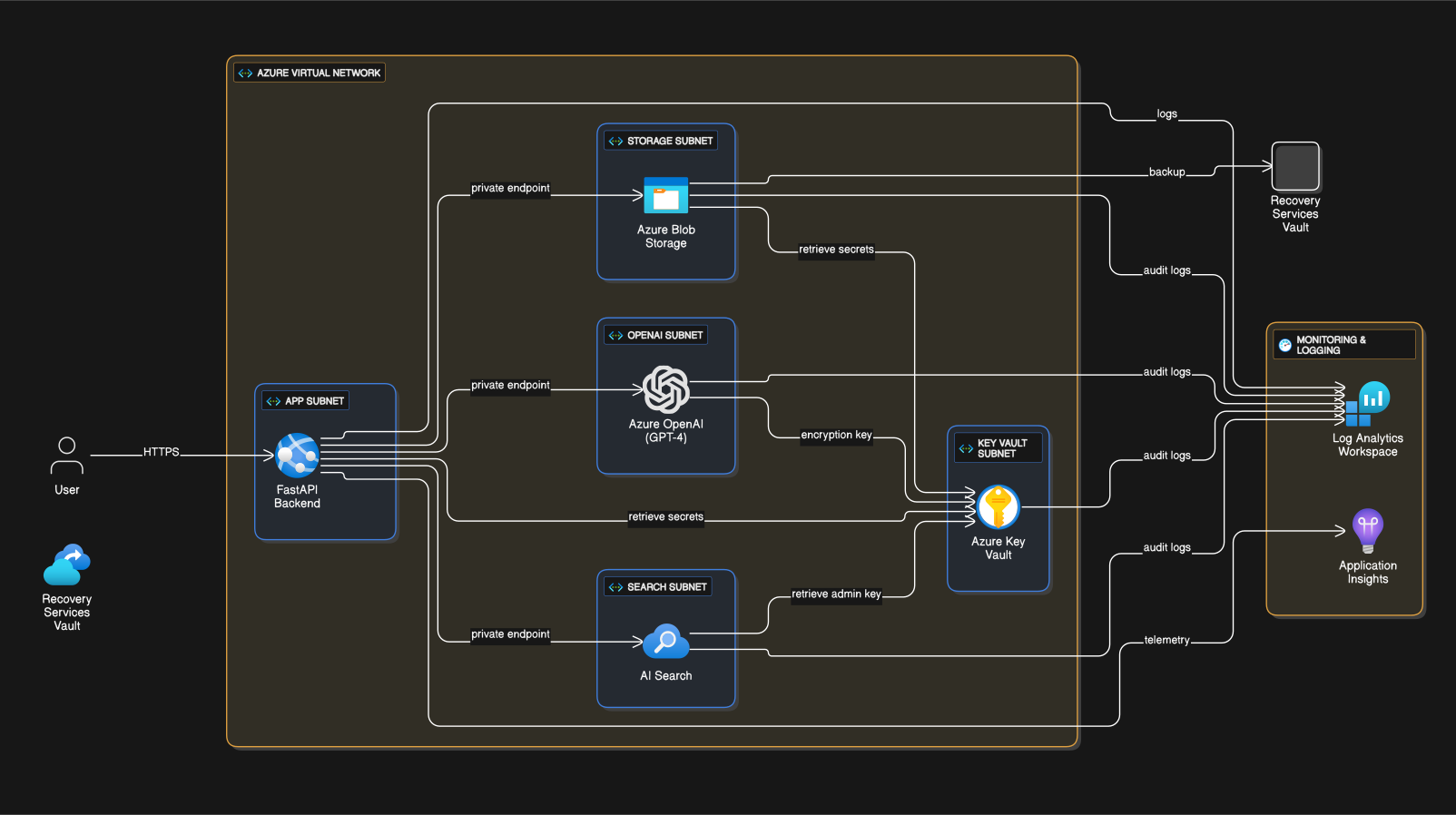
Designed RAG architecture with medical safety layers. Configured Azure environment with HIPAA-compliant controls (Private Endpoints, Key Vault, audit logging). Selected BioBERT embeddings for medical domain. Created data processing pipeline for document ingestion and PHI scrubbing.
Development & Integration (6 weeks)
Built document ingestion pipeline processing 2,500+ files. Implemented hybrid semantic search with medical taxonomy. Developed custom prompt engineering capturing physician’s voice. Created safety guardrails for high-risk query detection. Built React-based admin dashboard for content management.
Testing & Safety Validation (5 weeks)
Conducted physician review of 200+ test queries for voice fidelity and medical accuracy. Performed HIPAA compliance audit and penetration testing. Tested safety guardrails with edge cases (emergency symptoms, medication interactions). Achieved 95% physician approval rating on response quality.
Pilot Launch & Iteration (4 weeks)
Deployed to 5 staff members for internal pilot. Processed 400+ real patient queries. Collected feedback and refined prompts (20+ iterations). Achieved 4.8/5 patient satisfaction rating. Documented query patterns for continuous improvement.
Production Rollout & Training (8 weeks)
Full practice rollout with staff training. Implemented monitoring dashboard for query analytics and safety alerts. Established monthly content update process. Achieved 60% reduction in routine consultation volume. Planned Phase 2 patient portal integration.
Voice Fidelity Challenge
Capturing the physician’s unique communication style required iterative prompt engineering. We conducted 20+ interviews, analyzed 500+ historical patient communications, and created a detailed style guide covering:
- Warm, empathetic tone with personal anecdotes
- Evidence-based recommendations with holistic context
- Acknowledgment of patient autonomy and shared decision-making
- Clear disclaimers about consultation necessity
Medical Safety & Hallucination Prevention
Preventing medical misinformation was critical. We implemented:
- Strict Retrieval Requirements: Responses only from verified source documents
- Confidence Scoring: Low-confidence queries escalated to human review
- High-Risk Detection: Automatic flagging of emergency symptoms
- Disclaimer Injection: Every response includes “This is educational information, not medical advice”
HIPAA Compliance Complexity
Ensuring zero PHI exposure required careful data handling:
- All training documents scrubbed of patient identifiers
- Query logs anonymized and encrypted
- Azure OpenAI configured with no model training on customer data
- Regular compliance audits and penetration testing
Patient Education Efficiency
The medical knowledge assistant delivered significant operational improvements:
- 60% reduction in routine consultation volume
- Physician time savings: 12 hours per week reallocated to complex cases
- Patient satisfaction: 4.8/5 rating for assistant quality and helpfulness
- Query volume: 400+ patient queries per month with 95% satisfaction
Knowledge Preservation
The practice successfully captured institutional knowledge:
- 2,500+ documents indexed and searchable
- Junior practitioners using assistant for clinical decision support
- Consistent patient education across all staff members
Future Scalability
Phase 2 integration with patient portal planned for direct patient access, projected to reduce consultation volume by additional 30%.
Lessons Learned
- Voice Fidelity Requires Deep Domain Immersion: Capturing expert communication style demands extensive analysis of historical interactions, not just technical documentation.
- Healthcare AI Demands Zero-Tolerance Safety: Unlike general-purpose assistants, medical applications require multiple layers of safety guardrails and strict source attribution.
- HIPAA Compliance is Non-Negotiable: Healthcare AI projects must prioritize compliance from day one—retrofitting security is prohibitively complex.
- Iterative Prompt Engineering is Critical: Medical knowledge systems require 50+ prompt iterations to balance accuracy, empathy, and safety.
Appendices
Integration Overview
The system integrates with the practice’s existing infrastructure through:
- Document Sources: OneDrive for Business (physician’s document library), SharePoint (research repository)
- Authentication: Azure AD SSO for staff access
- Monitoring: Azure Application Insights for query analytics and error tracking
- Future Integration: Epic EHR patient portal API for direct patient access (Phase 2)
All integrations maintain HIPAA compliance with encrypted data transfer and Azure Private Link connectivity.
Model Selection Rationale
Azure OpenAI GPT-4: Selected for superior medical reasoning, long context window (128K tokens), and HIPAA-compliant deployment. GPT-4 demonstrated 30% higher medical accuracy than GPT-3.5-turbo in testing.
BioBERT Embeddings: Medical domain-specific embeddings outperformed general-purpose models by 40% in retrieving relevant clinical content. Fine-tuned on PubMed and clinical notes.
Hybrid Search Strategy: Combined semantic search (embeddings) with keyword search (BM25) to handle both conceptual queries and specific medical terminology lookups.
Cost Analysis
Monthly operational costs estimated at $800-$1,200 based on 400 queries/month:
- Azure OpenAI API: $500-$700 (GPT-4 usage at ~3,000 tokens/query)
- Azure AI Search: $150/month (Standard tier with 2,500 document index)
- Azure Storage: $50/month (document storage and embeddings)
- Monitoring & Logging: $100-$200/month (Application Insights, audit logs)
Security Architecture
HIPAA-compliant security implementation:
- Network Isolation: Azure VNet with Private Endpoints for all services (no public internet exposure)
- Encryption: TLS 1.3 in transit, AES-256 at rest for all data
- Key Management: Azure Key Vault for API keys and certificates
- Access Control: Azure AD with MFA, role-based access (physician/staff/admin)
- Audit Logging: Comprehensive logging to Azure Monitor with 7-year retention
- Data Residency: All data stored in US East region for regulatory compliance
- Backup: Daily automated backups with 30-day retention
-
HIPAA-compliant RAG system with encrypted data storage
-
Semantic search across 2,500+ medical documents and research papers
-
Source citation with medical literature references
-
Safety guardrails for high-risk medical queries
-
Voice and tone consistency matching physician’s communication style
-
Admin dashboard for content updates and query review
The medical knowledge assistant leverages Azure OpenAI Service, Azure AI Search, and BioBERT medical embeddings to deliver HIPAA-compliant, physician-quality responses with mandatory source citation and multi-layer safety guardrails.