
Healthcare Patient Engagement and Administrative Automation Platform
Please review our privacy policy and terms of service.

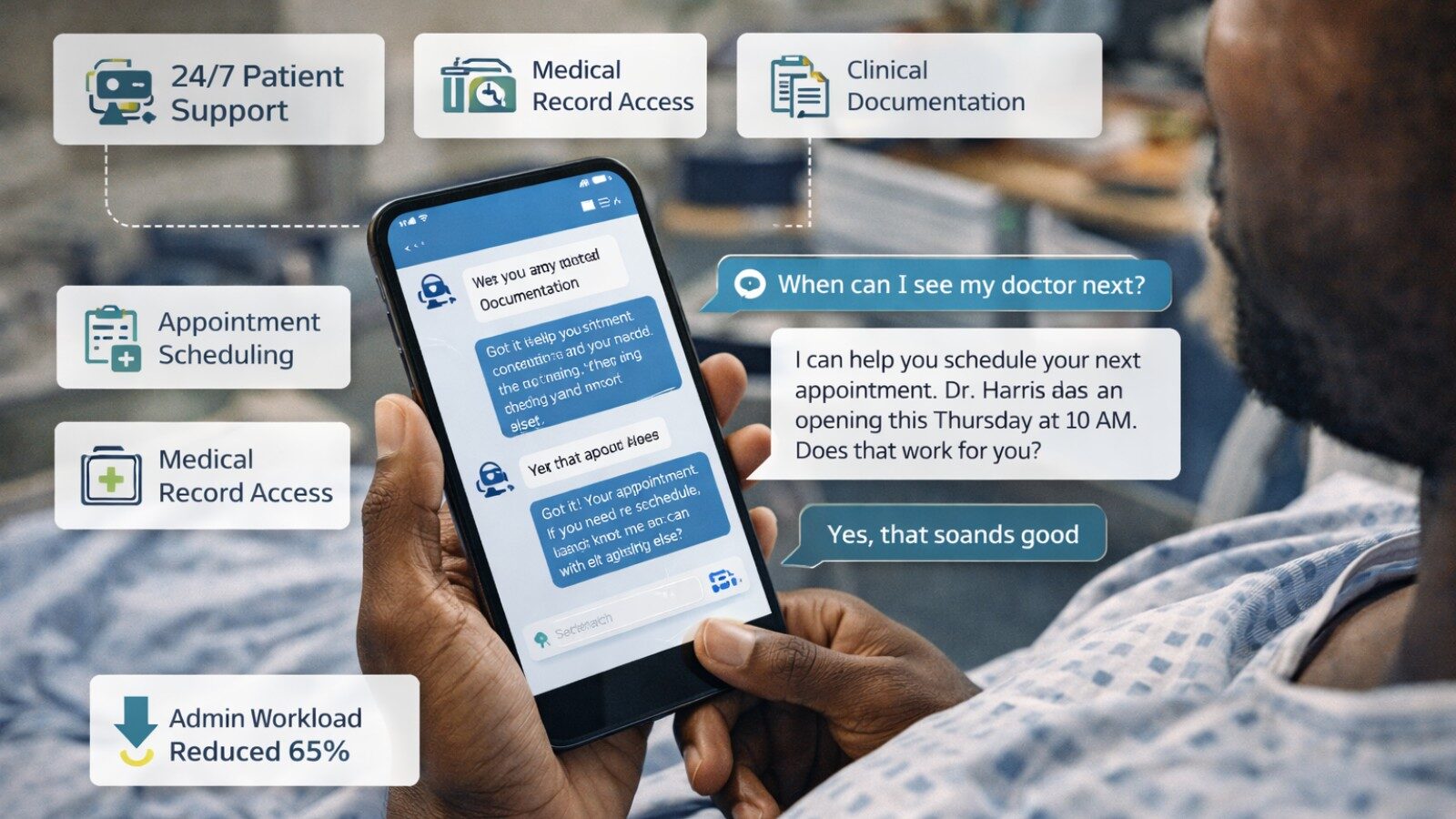
-
65% reduction in administrative staff workload
-
68% decrease in provider documentation time
-
NPS improvement from 28 to 61 (118% increase)
-
82% appointment self-scheduling rate
-
72% reduction in appointment wait times
-
No-show rate decreased from 18% to 6.2%
-
89% patient portal adoption (from 2% baseline)
-
78% reduction in phone call volume
Our customer, a multi-specialty medical group with 85 providers across 12 clinic locations, struggled with overwhelming administrative burden that consumed 40% of clinical staff time. Manual appointment scheduling, paper-based documentation, and repetitive patient inquiries resulted in long wait times, poor patient satisfaction (NPS of 28), and provider burnout.
The organization required a comprehensive patient engagement platform that could automate administrative tasks while improving the patient experience through modern digital interactions.
Business Context
The medical group operated with legacy systems and manual processes that created significant inefficiencies:
- Manual phone-based appointment scheduling consuming 6 FTE staff members
- Paper-based clinical documentation requiring 2.5 hours per provider daily
- 3,200+ monthly patient calls for routine questions (prescriptions, test results, appointments)
- Average patient wait time of 8.3 days for non-urgent appointments
- Patient satisfaction NPS of 28 (healthcare industry average: 42)
- Provider burnout scores in 82nd percentile
Strategic Objectives
Leadership identified critical goals for the digital transformation:
- Reduce administrative staff workload by at least 50%
- Improve patient satisfaction NPS to above industry average (>42)
- Decrease provider documentation time by 60%
- Enable 75% of appointments to be self-scheduled online
- Provide 24/7 patient support for routine inquiries
- Reduce no-show rate from 18% to under 8%
Existing Infrastructure
The medical group operated with fragmented systems and manual workflows:
- Epic EHR system used for clinical documentation and billing
- Phone-based appointment scheduling requiring staff intervention
- Basic patient portal with limited functionality (2% adoption rate)
- Manual insurance verification process taking 15-20 minutes per patient
- Paper-based intake forms requiring scanning and manual data entry
- No automated appointment reminders (18% no-show rate)
Technical Constraints
Several constraints shaped the solution design:
- Must maintain HIPAA compliance for all patient data
- Required bi-directional integration with Epic EHR
- Cannot disrupt existing clinical workflows during implementation
- Must support both English and Spanish language patients
- Provider adoption critical to success (need intuitive interfaces)
Discovery and Requirements
Conducted stakeholder interviews with providers, nurses, administrative staff, and patients to understand pain points and requirements. Documented existing workflows for appointment scheduling, clinical documentation, and patient communications. Established baseline metrics for administrative workload, provider documentation time, patient satisfaction, and no-show rates. Reviewed Epic EHR configuration and integration capabilities.
Architecture Design and Epic Integration
Designed comprehensive solution architecture using Azure health services and Epic FHIR APIs. Established HIPAA-compliant infrastructure with encryption, access controls, and audit logging. Developed integration patterns for bi-directional data exchange with Epic EHR. Created data models for patient portal, appointments, and clinical documentation. Obtained BAA (Business Associate Agreement) for Azure Health Data Services.
Patient Portal and Scheduling Development
Built responsive patient portal using React for web and mobile. Implemented intelligent appointment scheduling with AI-powered time slot optimization. Created digital intake forms with smart validation and EHR integration. Developed multi-channel automated reminder system (SMS, email, push notifications). Built patient chatbot using Azure Health Bot for common inquiries and symptom triage. Integrated with Epic for real-time appointment availability and booking.
Clinical Documentation AI Development
Fine-tuned Azure OpenAI GPT-4 model on 12,000 de-identified clinical notes. Built ambient AI documentation system capturing and transcribing patient encounters. Developed medical entity recognition using BioBERT for accurate terminology extraction. Implemented structured SOAP note generation with ICD-10 and CPT code suggestions. Created provider review interface for editing and approving AI-generated notes. Integrated with Epic for seamless note import and addendum workflow.
Testing, Security Audit, and Provider Training
Conducted comprehensive security testing and HIPAA compliance audit. Performed user acceptance testing with pilot group of 15 providers and 200 patients. Validated Epic integration for all supported workflows (scheduling, documentation, prescriptions, test results). Conducted penetration testing and vulnerability assessment. Developed training materials and conducted hands-on provider training sessions. Established support procedures and escalation paths.
Phased Rollout and Optimization
Executed phased deployment across 12 clinic locations over 4 weeks. Started with early adopter providers and gradually expanded to full organization. Monitored adoption metrics, patient satisfaction, and system performance daily. Provided on-site support at each clinic during first week of go-live. Collected provider feedback and implemented UX refinements. Tuned AI models based on real-world usage patterns. Documented lessons learned and best practices.
HIPAA Compliance and Data Security
Healthcare data security requirements demanded rigorous controls:
- Implemented Azure Health Data Services with BAA for HIPAA compliance
- All patient data encrypted at rest and in transit using FIPS 140-2 validated encryption
- Role-based access controls with multi-factor authentication
- Comprehensive audit logging of all PHI access and modifications
- Regular penetration testing and security assessments
EHR Integration Complexity
Bi-directional Epic integration required careful design:
- Implemented HL7 FHIR APIs for standardized data exchange
- Built custom middleware handling Epic-specific workflows and business logic
- Created conflict resolution system for concurrent updates to patient records
- Developed comprehensive error handling and retry mechanisms
- Established monitoring to detect integration issues within 60 seconds
AI Model Accuracy for Clinical Documentation
Medical note generation required exceptional accuracy:
- Fine-tuned GPT-4 model on 12,000 de-identified clinical notes
- Implemented medical entity recognition using BioBERT
- Created feedback loop allowing providers to correct AI-generated notes
- Achieved 94% provider acceptance rate after 3 months of tuning
- Built safeguards preventing AI hallucinations in clinical documentation
Provider Adoption and Change Management
Clinical staff adoption required thoughtful change management:
- Conducted 8 provider focus groups gathering feedback on workflows
- Implemented phased rollout starting with early adopter physicians
- Provided hands-on training and dedicated support during first month
- Created provider champions program to promote adoption
- Continuously refined UX based on provider feedback
Administrative Efficiency Gains
The platform dramatically reduced administrative burden:
- 65% reduction in administrative staff workload: From 6 FTE to 2.1 FTE for scheduling
- Reduced administrative labor cost: Redeployed staff to higher-value activities
- 82% of appointments self-scheduled: Exceeding 75% goal
- 78% reduction in phone call volume: From 3,200 to 704 monthly calls
Provider Productivity Improvements
Clinical documentation automation delivered substantial time savings:
- 68% reduction in documentation time: From 2.5 hours to 48 minutes per provider daily
- 1.5 additional patient visits per day per provider: Increased clinical capacity
- 46% improvement in provider satisfaction: Reduced burnout scores from 82nd to 44th percentile
Patient Experience Transformation
- NPS improvement from 28 to 61: Now exceeding industry average
- 72% reduction in appointment wait time: From 8.3 days to 2.3 days average
- No-show rate decreased from 18% to 6.2%: Through automated reminders
- 89% patient portal adoption rate: Up from 2% baseline
- 4.8/5.0 average patient satisfaction rating
Lessons Learned
This healthcare digital transformation project demonstrated several critical success factors:
1. Prioritize Provider Experience
Provider adoption was essential to success. Investing heavily in provider-centric design, comprehensive training, and responsive support during the first 90 days paid dividends. Providers became advocates rather than resistors once they experienced the time savings.
2. Start with High-Impact Use Cases
Beginning with appointment scheduling and reminders delivered immediate, visible benefits that built momentum for more complex features like AI documentation. Quick wins established credibility for the platform.
3. Security and Compliance Must Be Foundational
Healthcare data security requirements are non-negotiable. Building HIPAA compliance into the architecture from day one (rather than retrofitting) prevented costly rework and enabled faster deployment.
4. EHR Integration Is Make-or-Break
Seamless bidirectional integration with Epic proved critical to adoption. Providers would not use systems requiring duplicate data entry. The investment in robust FHIR integration was essential.
5. Bilingual Support Expands Impact
Supporting both English and Spanish language patients significantly expanded platform adoption in the community. The incremental effort to add language support had outsized impact on patient satisfaction.
Appendices
Integration Overview
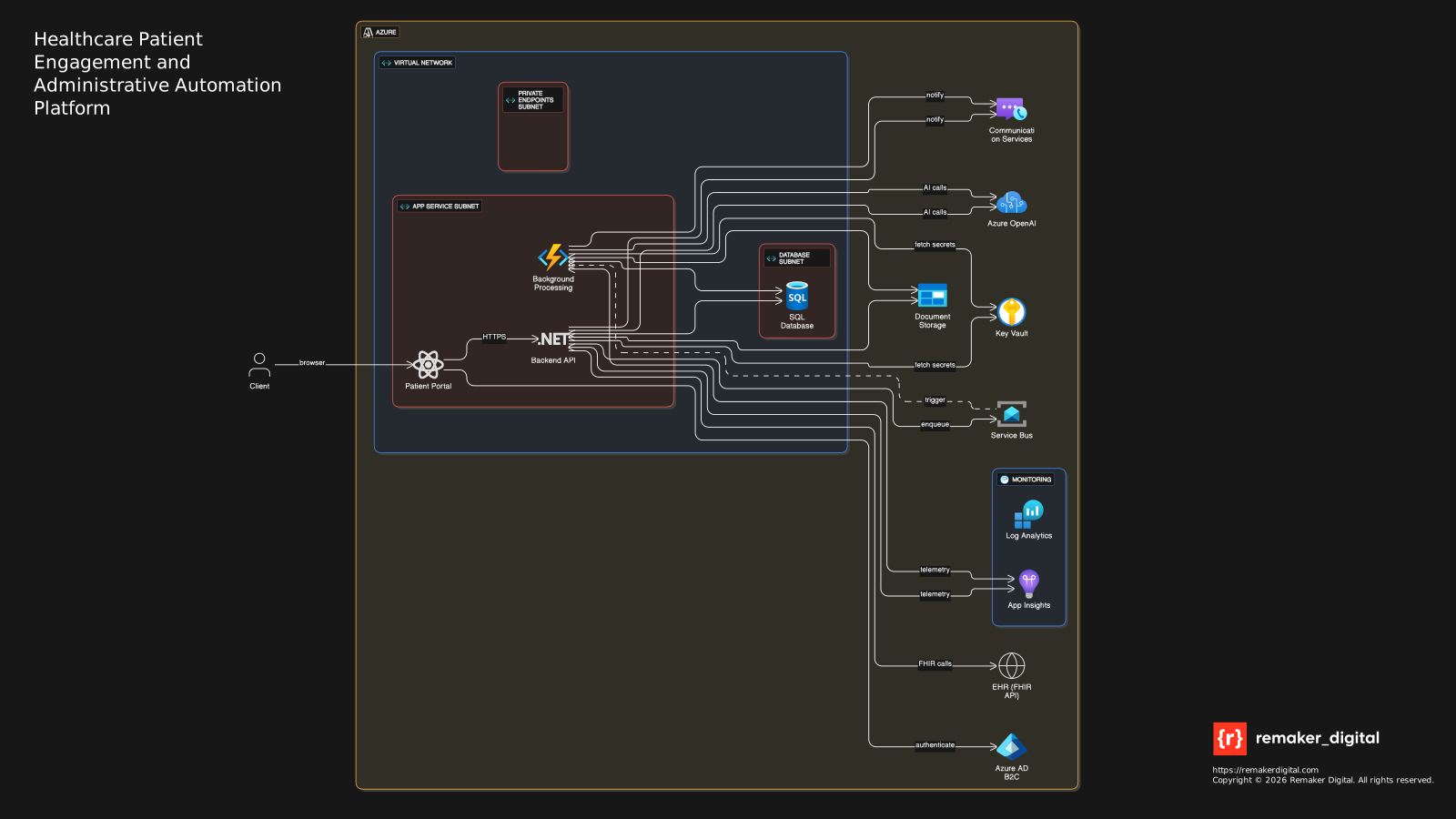
The platform integrates with Epic EHR using HL7 FHIR (Fast Healthcare Interoperability Resources) APIs for standardized healthcare data exchange. Azure API Management provides a secure gateway handling authentication, rate limiting, and monitoring of all Epic API calls.
Epic Integration Points
- Patient Demographics: FHIR Patient resource for profile information
- Appointments: FHIR Appointment and Slot resources for scheduling
- Clinical Notes: FHIR DocumentReference for note import
- Medications: FHIR MedicationRequest for prescription data
- Lab Results: FHIR Observation for test results
- Conditions: FHIR Condition for problem list
AI Model Selection for Clinical Documentation
Azure OpenAI GPT-4 selected for clinical documentation based on superior performance on medical reasoning tasks and ability to generate structured clinical notes from unstructured conversations.
Model Fine-Tuning
Fine-tuned GPT-4 on 12,000 de-identified clinical notes covering common encounter types: office visits, follow-ups, annual physicals, and urgent care. Training data included diverse specialties: primary care, cardiology, orthopedics, and pediatrics.
Medical NLP Pipeline
- Speech Recognition: Azure Speech Services transcribes provider-patient conversation
- Entity Extraction: BioBERT identifies medical terms, conditions, medications, procedures
- Note Generation: GPT-4 generates structured SOAP note from transcript and entities
- Code Suggestion: ICD-10 and CPT codes suggested based on documentation
- Quality Check: Validation rules ensure note completeness and accuracy
Safety Mechanisms
- Hallucination detection preventing fabricated medical information
- Required provider review and approval before Epic integration
- Audit trail of all AI-generated content and provider edits
- Continuous monitoring of note quality and provider acceptance rate
Cost Analysis
Platform operational costs estimated at $285,000 annually:
Azure Infrastructure Costs
- Azure OpenAI Service: $72,000/year for GPT-4 clinical documentation
- Azure Health Data Services: $48,000/year for HIPAA-compliant storage
- Azure Health Bot: $36,000/year for patient chatbot
- Azure API Management: $24,000/year for Epic integration
- Azure App Service: $42,000/year for web/mobile apps
- Azure Speech Services: $18,000/year for transcription
- Azure Monitor: $12,000/year for logging and telemetry
- SMS/Email: $18,000/year for automated reminders
- Support & Maintenance: $15,000/year
HIPAA Compliance Architecture
The platform implements comprehensive HIPAA security and privacy controls:
Data Encryption
- All PHI encrypted at rest using FIPS 140-2 validated encryption
- TLS 1.3 for all data in transit
- Azure Key Vault for encryption key management
- Field-level encryption for highly sensitive data (SSN, financial)
Access Controls
- Azure AD with multi-factor authentication for all users
- Role-based access control (RBAC) enforcing minimum necessary principle
- Conditional access policies based on device compliance and location
- Just-in-time (JIT) privileged access for administrators
Audit and Monitoring
- Comprehensive audit logging of all PHI access and modifications
- Azure Sentinel for security monitoring and threat detection
- Automated alerts for suspicious access patterns
- Quarterly access reviews and compliance audits
Business Continuity
- 99.9% uptime SLA with multi-region deployment
- Automated daily backups with 30-day retention
- RPO: 15 minutes for patient data
- RTO: 4 hours for full service restoration
- Documented disaster recovery procedures tested quarterly
-
AI-powered appointment scheduling and reminder system
-
Intelligent patient portal with natural language interface
-
Automated clinical documentation using ambient AI
-
24/7 patient support chatbot for common inquiries
-
Integration with Epic EHR for seamless data exchange
-
Automated insurance verification and eligibility checks
The platform leverages Azure Health Bot for intelligent patient triage, Azure OpenAI Service (GPT-4) for ambient clinical documentation, and Azure Health Data Services for HIPAA-compliant data storage. Integration with Epic EHR uses HL7 FHIR APIs for bi-directional patient data exchange.