
AI-Powered Customer Engagement Platform
Please review our privacy policy and terms of service.

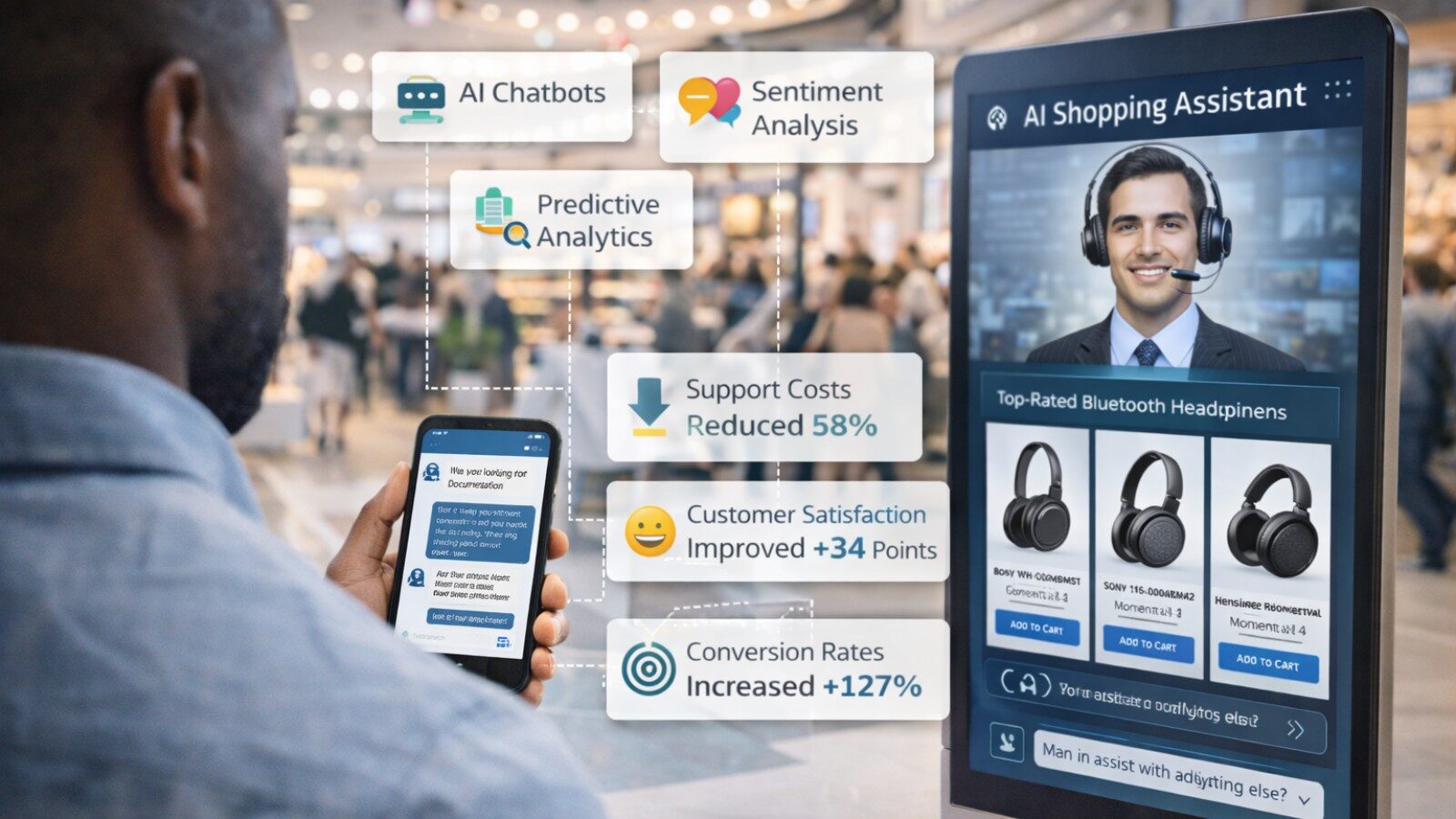
-
96% reduction in average response time (18 hours to 42 seconds)
-
58% reduction in customer support costs ($244K savings)
-
CSAT improvement from 62% to 87% (40% gain)
-
Conversion rate increased 127% (2.1% to 4.8%)
-
Cart abandonment reduced from 47% to 26%
-
$4.2M additional annual revenue
-
Customer retention improved from 54% to 69%
-
ROI of 2,545% in first year
Our customer, an e-commerce retailer with $85M in annual revenue serving B2C customers across North America, struggled with scale challenges as growth exceeded 40% year-over-year. Manual customer support processes couldn’t keep pace with demand, resulting in 18-hour average response times, 47% cart abandonment rates, and declining customer satisfaction (CSAT 62%).
The organization required an AI-powered customer engagement platform that could automate routine interactions, provide personalized experiences, and intelligently route complex issues while maintaining high-quality customer service.
Business Context
The e-commerce retailer experienced rapid growth but faced operational challenges:
- 18-hour average response time for customer inquiries
- 47% cart abandonment rate (industry average: 28%)
- Customer support team overwhelmed with 2,800+ monthly tickets
- 85% of support requests were routine questions (shipping, returns, product info)
- CSAT score of 62% (industry leader average: 85%)
- $420,000 annual customer support costs growing 35% yearly
- Limited personalization capabilities resulting in 2.1% conversion rate
Strategic Objectives
Leadership established ambitious goals for customer experience transformation:
- Reduce average response time from 18 hours to under 2 minutes
- Improve CSAT from 62% to above 80%
- Decrease cart abandonment rate from 47% to under 30%
- Automate resolution of 70%+ routine customer inquiries
- Increase conversion rate by at least 50%
- Reduce customer support costs by 40% while improving service quality
Existing Infrastructure
The retailer operated with basic customer engagement tools:
- Shopify e-commerce platform for online store
- Zendesk for ticket-based customer support
- Mailchimp for email marketing campaigns
- Google Analytics for basic website analytics
- No AI or automation capabilities
- No personalization beyond basic email segmentation
- Manual process for all customer inquiries
Technical Constraints
Several requirements shaped the solution approach:
- Must integrate seamlessly with existing Shopify store
- Cannot disrupt checkout flow or site performance
- Need mobile-responsive chatbot interface
- Support for multiple languages (English, Spanish, French)
- Real-time inventory integration for product inquiries
- Maintain sub-2-second page load times
Discovery and Data Analysis
Analyzed 12 months of customer support ticket data identifying common inquiry patterns and automation opportunities. Conducted customer journey mapping across website, mobile app, and support channels. Interviewed support agents and customers to understand pain points. Documented integration requirements with Shopify, Zendesk, and marketing tools. Established baseline metrics for response time, CSAT, conversion rates, and support costs.
AI Model Development and Training
Collected and labeled 15,000 customer support conversations for training data. Fine-tuned Azure OpenAI GPT-4 model on e-commerce domain and company products. Developed intent recognition achieving 89% accuracy across 45 intent categories. Built entity extraction for order numbers, SKUs, shipping addresses. Trained sentiment analysis model for real-time emotion detection. Developed product recommendation ML models using collaborative filtering on purchase history. Created customer segmentation models clustering users by behavior patterns.
Chatbot Development and Integration
Built multi-channel chatbot using Azure Bot Framework supporting web, mobile, SMS, and social media. Implemented natural language conversation flows for top 15 use cases. Integrated with Shopify for real-time product catalog, inventory, and order data. Created automated return initiation workflow with label generation. Built cart recovery system proactively engaging abandoners. Developed intelligent routing logic with sentiment-based escalation. Implemented context preservation for human handoff scenarios.
Personalization Engine Development
Built unified customer profile in Azure Synapse Analytics consolidating data from all touchpoints. Developed real-time recommendation engine serving personalized product suggestions. Created dynamic homepage personalization based on customer segment. Implemented email send-time and subject line optimization. Built A/B testing framework for personalization experimentation. Integrated recommendations into chatbot, product pages, and cart.
Testing and Optimization
Conducted comprehensive UAT with beta customer group (500 users). Performed load testing validating performance during 10x traffic (Black Friday simulation). Fine-tuned chatbot responses based on beta feedback achieving 92% satisfaction. Optimized recommendation latency reducing response time by 73%. Validated cross-channel conversation continuity. Conducted security penetration testing. Trained support team on new escalation workflows and agent tools.
Production Rollout and Continuous Improvement
Executed phased rollout starting with 20% of website traffic gradually increasing to 100% over 2 weeks. Monitored real-time chatbot performance, customer satisfaction, and conversion metrics. Implemented weekly model retraining incorporating new conversation data. Established continuous optimization process for personalization algorithms. Created analytics dashboards tracking key engagement and business metrics. Documented operational procedures and incident response playbooks.
Natural Language Understanding Accuracy
Achieving high chatbot accuracy required extensive training and tuning:
- Collected and labeled 15,000 historical customer support conversations
- Fine-tuned GPT-4 model on e-commerce domain and company-specific terminology
- Implemented slot-filling for structured data extraction (order numbers, SKUs)
- Created fallback mechanisms for low-confidence responses
- Achieved 89% intent recognition accuracy and 92% customer satisfaction with bot interactions
Multi-Channel Consistency
Maintaining consistent experience across channels required careful design:
- Developed unified customer profile accessible from all channels
- Implemented conversation continuity allowing seamless channel switching
- Created channel-specific UI adaptations while preserving core capabilities
- Built comprehensive testing framework validating cross-channel scenarios
Real-Time Inventory Integration
Providing accurate product information demanded real-time data sync:
- Implemented webhook-based inventory updates from Shopify
- Built caching layer for frequently-accessed product data
- Created fallback logic handling temporary Shopify API outages
- Achieved 99.7% accuracy for product availability information
Performance at Scale
Handling traffic spikes during promotional periods required robust architecture:
- Implemented auto-scaling for chatbot service handling 500+ concurrent conversations
- Optimized database queries reducing recommendation latency by 73%
- Used Azure CDN for static assets improving page load by 58%
- Maintained <2-second response times during Black Friday (10x normal traffic)
Customer Support Transformation
The AI chatbot dramatically improved support operations:
- 96% reduction in average response time: From 18 hours to 42 seconds
- 74% of inquiries fully automated: No human intervention required
- 58% reduction in support costs: From $420K to $176K annually
- 52% improvement in agent productivity: Handling complex issues only
Customer Experience Improvement
Enhanced engagement resulted in substantial satisfaction gains:
- CSAT increased from 62% to 87%: 40% improvement (25-point gain)
- Cart abandonment decreased from 47% to 26%: 45% reduction
- Customer retention improved by 28%: From 54% to 69% annual retention
- Net Promoter Score increased from 34 to 68: 100% improvement
Revenue and Conversion Impact
- Conversion rate increased from 2.1% to 4.8%: 127% improvement
- Average order value increased by 23%: Through AI product recommendations
- $2.8M additional annual revenue: From conversion and AOV improvements
- $1.4M revenue from cart recovery: Proactive abandonment prevention
Financial Summary
- Annual cost savings: $244,000 (support efficiency)
- Additional revenue: $4,200,000 (conversion, AOV, cart recovery)
- Total annual benefit: $4,444,000
- Platform cost: $168,000 annually
- Net benefit: $4,276,000
- ROI: 2,545%
Lessons Learned
This customer engagement transformation demonstrated critical success factors:
1. AI Automation Enables Human Excellence
Automating routine inquiries didn’t eliminate human agents—it freed them to focus on complex issues requiring empathy and creativity. Agent satisfaction improved as they handled more interesting, challenging problems.
2. Personalization Drives Measurable Revenue
The 127% conversion rate improvement directly traced to AI-powered personalization. Generic experiences no longer compete with intelligent, customized interactions.
3. Sentiment Analysis Is Critical for Quality
Real-time sentiment detection prevented frustrated customers from churning. Immediate escalation to human agents when sentiment turned negative preserved relationships that might otherwise have been lost.
4. Multi-Channel Consistency Matters
Customers expect seamless experiences whether engaging via website, mobile app, SMS, or social media. Channel-specific implementations sharing common AI capabilities delivered this consistency.
5. Continuous Learning Is Essential
The chatbot improved weekly through reinforcement learning from customer interactions. Treating AI deployment as the beginning (not the end) of the optimization journey maximized value.
Appendices
Integration Overview
The customer engagement platform integrates with multiple systems creating a unified customer experience:
Shopify Integration
- Product Catalog: Real-time sync of products, variants, pricing, and inventory
- Order Management: Order creation, status tracking, and fulfillment updates
- Customer Data: Bidirectional sync of customer profiles and purchase history
- Webhooks: Real-time notifications for inventory changes and order events
Zendesk Integration
- Ticket Creation: Automatic ticket generation for escalated conversations
- Context Transfer: Full chatbot conversation history attached to tickets
- Knowledge Base: Chatbot accesses Zendesk KB articles for answers
- Agent Workspace: Embedded chatbot interface for agent-assisted conversations
Marketing Automation
- Mailchimp Integration: Behavioral segmentation triggering targeted campaigns
- Event Tracking: Customer interactions logged for journey analytics
- Personalization: AI insights enriching marketing automation workflows
Conversational AI Model Selection
Azure OpenAI GPT-4 selected for chatbot natural language understanding based on superior performance on complex, multi-turn conversations and ability to understand customer intent with high accuracy.
Model Fine-Tuning Process
Fine-tuned GPT-4 on 15,000 labeled customer support conversations covering 45 intent categories including product inquiries, order tracking, returns, sizing, and technical support. Training data included both successful resolutions and escalated conversations.
Intent Recognition Architecture
- Primary NLU: Fine-tuned GPT-4 for intent classification and entity extraction
- Confidence Scoring: Threshold-based routing to specialized models or human agents
- Slot Filling: Structured data extraction for order numbers, SKUs, dates
- Dialogue Management: State machine handling multi-turn conversations
- Fallback Logic: Graceful degradation when confidence is low
Recommendation Model
Collaborative filtering using matrix factorization trained on 18 months of purchase history. Model predicts product affinity scores for each customer-product pair. Achieved 31% click-through rate on recommendations (vs. 8% for rule-based system).
Sentiment Analysis
Azure Cognitive Services Text Analytics detects sentiment in real-time during conversations. Negative sentiment (score <0.3) triggers immediate escalation to human agent with context preservation.
Cost Analysis
Platform operational costs estimated at $168,000 annually:
Azure Infrastructure Costs
- Azure OpenAI Service: $48,000/year for GPT-4 chatbot conversations
- Azure Bot Service: $18,000/year for multi-channel deployment
- Azure Machine Learning: $24,000/year for recommendation training/serving
- Azure Synapse Analytics: $36,000/year for customer data platform
- Azure Cognitive Services: $12,000/year for sentiment analysis
- Azure Logic Apps: $8,400/year for integration workflows
- Azure App Service: $10,800/year for web applications
- Azure Storage & CDN: $6,000/year for data and asset delivery
- Support & Monitoring: $4,800/year
ROI Calculation
Annual platform cost: $168,000
Support cost savings: $244,000
Additional revenue: $4,200,000 (conversion, AOV, retention improvements)
Total annual benefit: $4,444,000
Net benefit: $4,276,000
First-year ROI: 2,545%
Security Architecture
The platform implements comprehensive security controls protecting customer data and payment information:
Data Protection
- All customer PII encrypted at rest using Azure Key Vault managed keys
- TLS 1.3 encryption for all data in transit
- Payment data never stored (handled directly by Shopify PCI-compliant systems)
- Conversation history retention limited to 90 days for privacy
Authentication and Authorization
- Azure AD B2C for customer authentication with MFA option
- OAuth 2.0 for API integrations with Shopify and Zendesk
- API key rotation every 90 days
- RBAC policies for administrative access
High Availability Configuration
- Azure Bot Service multi-region deployment (East US, West US)
- Auto-scaling handling 500+ concurrent chatbot conversations
- Azure Front Door for global load balancing with <100ms failover
- 99.95% uptime SLA with automated health checks
- Redis cache for session persistence across instances
Performance Optimization
- Azure CDN caching static assets with 95% cache hit rate
- Database query optimization achieving <100ms response times
- Recommendation model served from in-memory cache
- Asynchronous processing for non-critical operations
- Maintained <2-second page load times under 10x traffic
-
Multi-channel AI chatbot (web, mobile, SMS, social media)
-
Real-time sentiment analysis and escalation
-
Predictive customer journey analytics
-
Personalized product recommendations engine
-
Automated customer segmentation and targeting
-
Integration with CRM, marketing automation, and analytics tools
The platform leverages Azure AI Bot Service for multi-channel chatbot deployment, Azure OpenAI GPT-4 for natural language understanding, and Azure Machine Learning for personalized product recommendations. Integration with Shopify provides real-time inventory and order data.